




North American Professional Norms
Introduction
The release of the Professional Norm provides users with increased flexibility in the use of EQ-i 2.0. This new feature was created based on rigorous science and with customer needs in mind. General Population norms have the widest scope and allow for comparisons to norms reflecting the average person in the North American population. Professional norms allow consultants the option of using a norm that is more relevant to the people they work with every day: working professionals. This chapter describes how this new norm group was created to provide consultants with additional options to enrich their work.
| This chapter describes the development of the EQ-i® 2.0 Professional Norm sample. For information on the EQ-i 2.0, including administration, interpretation, or development of the General Population Norm, please refer to Parts I–V of the EQ-i 2.0 User’s Handbook. |
In 2011, the EQ-i 2.0 was released with a General Population Norm sample, consisting of 4,000 people who closely represented the North American population at this point in time (refer to Standardisation, Reliability, and Validity for more details). This General Population Norm group is used to compare your client’s score to the general (or average) North American, and is representative of the age, gender, ethnicity, and education compositions of North America. In essence, using the General Population Norm to compare your client’s score to the average person's score on the EQ-i 2.0 is the broadest comparison you can make. Such comparisons help you answer the following question, “How does my score compare to typical people in the general population?” This norm would include both working and non-working individuals, people with high and low education levels, etc.
Sometimes you or your client may want a more specific comparison. For instance, you may want to compare your client to other similar individuals, such as other professionals. The Professional Norm enables you to do just that: it allows you to compare your client’s score to professionals rather than to the average person.
The Professional Norm does not replace the General Population Norm, but is another option you may select from when generating your EQ-i 2.0 reports.
The Professional Norm sample includes 1,400 individuals who are employed or self-employed and have at least some post-secondary education. In other words, these norms reflect the individuals you will most commonly encounter in consultancy in professional contexts. (See Data Collection for the Professional Norm Sample for more information on the Professional Norm sample.)
The Professional Norm sets the bar higher for your client’s EQ-i 2.0 scores; this norm group is more educated and more representative of corporate and/or managerial employees than the General Population Norm.
If you are administering the EQ-i 2.0 to an individual who you consider to be a professional, select the Professional Norm option. Selecting the Professional Norm option means that you are comparing your client’s score to other like individuals (professionals). Your client's work environment is likely made up of professionals, and he/she is likely to be gauged against other professionals when applying for jobs and promotions, as well as when considering development opportunities, and other career related opportunities.
Similar to the General Population Norm, there is both an Overall Professional Norm, and a Professional Norm that is broken down into Age and Gender Specific norm groups. If you use the Overall norm, the normative comparison will not be affected by the individual’s age or gender (for example, a 58-year-old male will be compared to all individuals in the Professional Norm sample regardless of their age or gender). If you use the Age and Gender Specific norm, then the comparison will be made only to professionals of the same gender and age group (for example, a 58-year-old male will only be compared to males who are 50-59 years of age). There are sound reasons for using either of these options, and the choice ultimately belongs with the preference of the test administrator. Some users prefer not to use the Age and Gender Specific norms because everyone is then scored against the same norm values. On the other hand, others like the specificity of comparing individuals directly to those that are most similar in terms of age and gender.
Scoring a client’s EQ-i 2.0 results with the Professional Norms will generally result in lower scores than those obtained using the General Population Norms. The decrease is not always the same from one subscale to the next and from one score to the next.
Example 1 illustrates the effect on scores of using the different norm groups for Jeanine—a 37-year-old female Human Resources Specialist, based in New York. When Jeanine’s coach scored her EQ-i 2.0 results with the General Population Norms, many scores were in the High range (i.e., ≥ 110), including the Total EI score. This means that when Jeanine is compared to the general North American population, she has emotional intelligence that is higher than typical. In contrast, when Jeanine’s coach re-scored her EQ-i 2.0 results using the Professional Norms, her scores mostly fell in the Average range (her scores decreased by 4 to 8 points depending on the scale). This means that Jeanine’s emotional intelligence is fairly typical when compared to other professionals.
Example 1. Jeanine’s EQ-i 2.0 Scores Using General Population and Professional Norms
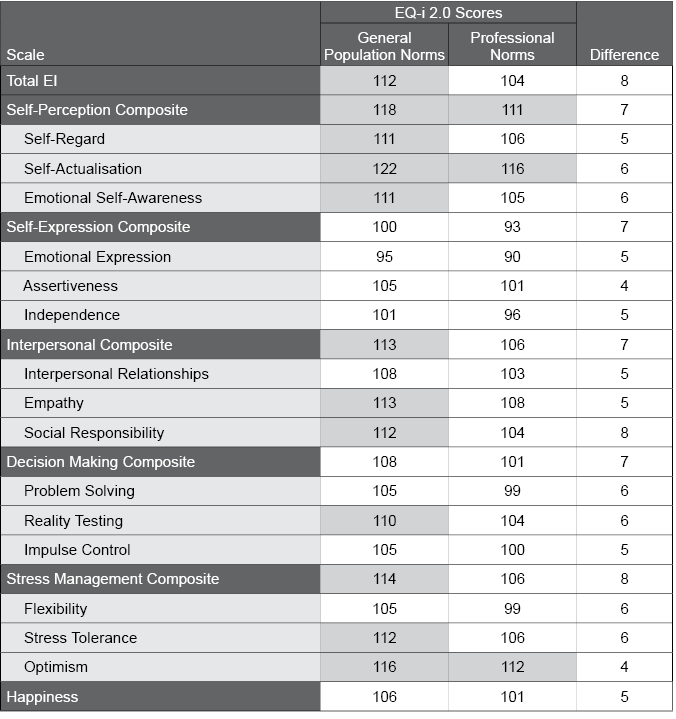
Note: Shaded cells indicate scores that fall in the High range.
| All tables and figures representing detailed depictions of the analyses described in this chapter are available in Appendix B. |
Standardisation is an important part of test development, because it involves the collection of normative data. This section describes the method of data collection and the breakdown of the normative samples, including the effects of age and gender on the EQ-i 2.0 results.
Data Collection for the Professional Norm Sample
Data collection for the Professional Norm sample took place over two phases. The first phase (Phase 1) of data collection took place from March, 2010 to December, 2010, as part of the full standardisation process for the EQ-i 2.0. Data from Phase 1 (N = 700) comprises a subset of 571 professionals from the General Population Norm sample, as well as 129 leaders from a leadership validity study. The sample was selected from all regions in the United States and Canada, and also had good representation from various race/ethnicities (64.0% White, 15.7% Hispanic/Latino, 10.4% Black, 6.7% Asian, and 3.3% Other). This sample included only employed/self-employed professionals who had at least some post-secondary education (i.e., 15.0% had some college or university completed, 11.3% had a college diploma, 42.5% graduated from university with a bachelor’s degree, and 31.3% had a post-graduate or professional degree). The second phase (Phase 2) of data collection took place between July, 2011 and December, 2011. This sample (N = 700) included data from a randomly selected set of 700 employed/self-employed EQ-i 2.0 customers.
The total Professional Norm sample includes 1,400 individuals (N = 1,260 [90%] from the United States, and N = 140 [10%] from Canada). The sample includes an equal number of men and women, with a good spread across the age groups (see Table B.1 for the age x gender distribution of the sample; note that the 60+ group is smaller due to a higher proportion of retired individuals in this age group). The individuals in this sample were employed in a variety of professional occupations (see Table B.2 for a breakdown of employment areas).
Normative Phase
NORMING PROCEDURES
The first step in norm preparation was to determine if any trends existed in the data. For instance, large differences in scores between men and women, or across various age groups, could provide an argument for creating separate gender- or age-based norm groups. Conversely, a lack of such differences may dictate the use of a single norm group with gender and age groups combined. A series of analyses of covariance (ANCOVA; for Total EI) and multivariate analyses of covariance (MANCOVA; for the Composites and Subscales) was used to examine the relationships between gender and age with EQ-i 2.0 scores. Five age groups were used for this analysis: 18–29 years, 30–39 years, 40–49 years, 50–59 years, and 60+ years. In an attempt to control for Type I errors that might occur with multiple analyses, a more conservative criterion of p < .01 was used for all F-tests.
The Wilk’s lambda statistic generated from these analyses ranges from 0.00 to 1.00, and conveys the proportion of variance that is not explained by the effect (in this case, the interaction between gender and age) in the multivariate analyses. These values were all close to 1.00, suggesting that only a small amount of variance could be explained. However, F-tests revealed significant effects of gender and age for both the composite scale and subscale analyses, as well as a significant gender by age interaction for the subscales (see Table B.3). Given these results, the univariate effects are described in detail next.
AGE AND GENDER EFFECTS
Gender Effects. Results from the gender analyses showed that males and females did not differ significantly on the EQ-i 2.0 Total EI score, indicating that overall emotional intelligence (as measured by the EQ-i 2.0) is the same for males and females. However, small to medium gender effects were found for some composite scales and subscales (see Table B.4 for the effect sizes and Table B.5 for descriptive statistics and significance test results). The largest difference was on Empathy; women scored higher than men with a moderate effect size (d = -0.47). Smaller differences were also found; women scored higher than men on the Interpersonal Composite (d = -0.37), Emotional Expression (d = -0.34), Emotional Self-Awareness (d = -0.28), and Interpersonal Relationships (d = -0.23). Finally, small effects were also found; men scored higher than women on both Problem Solving (d = 0.25) and Stress Tolerance (d = 0.24). While there were several gender effects, it is important to note that overall gender effects were relatively small and represent only a few absolute standard score points.
Age Effects. Results of the age analyses revealed several small effects of age on EQ-i 2.0 scores (see Table B.4 for the effect sizes and Table B.6 for descriptive statistics and significance test results). Although the exact pattern of effects changes from scale to scale, there was a general tendency for scores to increase with age. More specifically, the lowest scores for the majority of the scales were found in the 18–29 or 30–39 year-old groups. Scores increased somewhat in the 40–49 and 50–59 year-old groups, and tended to increase again slightly in the 60+ group.
Gender × Age Interaction. There were no interactions between age and gender, and partial η2 values were all 0.00 to 0.01 (see Table B.4); this indicates that age effects were consistent across males and females, and any gender effects were consistent across age groups.
NORM GROUPS AND NORM CONSTRUCTION
Overall, similar to what was found in the General Population Norm sample, the age and gender analyses revealed significant, but relatively small effects. Therefore, specific Age and Gender Professional Norms, as well as an Overall Professional Norm (i.e., collapsed across ages and genders) were both developed. Similar to results found in the General Population Norm sample, results from the Professional Norm sample revealed that skewness and kurtosis values were close to 0 (skewness values ranged from
-0.86 to -0.24; kurtosis values ranged from -0.19 to 0.78) and did not reveal any significant departures from a bell-shaped (Gaussian) curve. Therefore, following the procedures used with the General Population Norm sample, artificial transformation of scores was deemed unnecessary. Actual construction of the norms was conducted in the same manner as the General Population Norms (see Standardisation, Reliability, and Validity for more information on the construction of the General Population Norm).
Internal Consistency
Internal consistency conveys the degree to which a set of items are associated with one another. High levels of internal consistency suggest that the set of items are measuring a single, cohesive construct. Internal consistency is typically measured using Cronbach’s alpha (Cronbach, 1951). Cronbach’s alpha ranges from 0.0 to 1.0 and is a function of (a) the interrelatedness of the items that comprise a scale and (b) the number of items that comprise a scale (John & Benet-Martinez, 2000). Higher values reflect higher internal consistency.
Cronbach’s alpha values for the EQ-i 2.0 scales in the normative sample are presented in Table B.7 (see Standardisation earlier in this chapter for a description of the normative sample). Given that Cronbach’s alpha is influenced by the number of items on a scale (with more items generally leading to higher alphas), the number of items per scale is also displayed in this table. The majority of the values found in Table B.7 demonstrate excellent reliability for the EQ-i 2.0. In the Overall column, the alpha value for the Total EI scale was .97, values for the composite scales ranged from .87 to .92, and values were .75 or higher for every subscale. These values were similar within the various age and gender normative groups, including a Total EI alpha of at least .95 in each norm group. The high level of internal consistency found in the EQ-i 2.0 Total EI score supports the idea that the EQ-i 2.0 items are measuring a single cohesive construct—namely, emotional intelligence.
Comparing the General Population and Professional Norms
Because the individuals in the Professional Norm sample have professional careers and are more educated than those in the General Population Norm sample, it was hypothesized that the professionals should score higher than the general population. In order to test this hypothesis, EQ-i 2.0 scale scores for these two groups were compared to each other. As expected, the Professional Norm sample scored 4.5 to 9.7 standard score points higher (M difference = 6.4 standard scores) than the General Population Norm sample (see Table B.8).
Large Scale Analysis of Professional Norms
In order to determine what the distribution of scores from EQ-i 2.0 customers would look like when scored with the Professional Norms, data from a sample of 4,000 EQ-i 2.0 customers (collected from July, 2011 to December, 2011) were scored using the Professional Norms. Individuals in this sample came from both the United States (76.5%) and Canada (23.5%); 53.6% of the sample were male, and ranged in age from 18 to 80 years (M age = 40.8 years; SD=12.4 years). Results from this sample (see Table B.9) revealed that when using the Professional Norms, the average scores were very close to 100 (M=100.2 to 103.5), and the standard deviations were very close to 15 (SD=13.7 to 16.3). Furthermore, skewness and kurtosis values for this sample were small (skewness values ranged from -.95 to -.34; kurtosis values ranged from -0.15 to 1.11) indicating that the distribution of scores approximates a bell-shaped (Gaussian) curve. These values, combined with an examination of the scale histograms indicate a very slight negative skew, with no significant departures from a bell-shaped (Gaussian) curve (see Figure B.1.)